Why Audits Aren't Enough: Building Proactive Security Into Your Web3 Development Process
Smart contract audits have become the gold standard for Web3 security, but they were never meant to be the only line of defense. In the latest episode of the Security Table podcast, our team explored why proactive security tooling isn't just a nice-to-have, but an absolute necessity for any serious Web3 project.
The Brutal Reality: Audits Miss What Simple Tools Catch
At Olympix, we run exploit postmortems after every major hack in the space. Time and again, our tools identify vulnerabilities that slipped through audited code. This doesn't happen because auditors are incompetent, but because audits are fundamentally constrained by human bandwidth, time limitations, and the sheer complexity of modern smart contract systems.
When a simple automated tool can catch what a manual audit missed, the implications are clear: these tools need to be standard practice, not optional add-ons.
You're Setting Your Audit Up to Fail
Going into an audit with code full of vulnerabilities dramatically reduces the audit's effectiveness. When auditors encounter numerous low-hanging fruit issues, they spend valuable time on problems that automated tools could have caught, leaving less bandwidth for sophisticated vulnerabilities that actually require human expertise.
The Hidden Costs of Unprepared Audits
VCs we partner with regularly see this pattern: a portfolio company submits code for audit, receives a report filled with vulnerabilities, and gets told to fix everything and come back for a second audit. The first report never gets published because it would signal poor code quality to potential investors and users.
This means double the audit spend on issues that internal tooling could have addressed before the first audit even began. Beyond the financial cost, each remediation cycle delays deployment, pushes back product launches, and extends time-to-market.
More critically, overloading auditors with basic issues increases the likelihood they'll miss something important. The more noise in your codebase, the harder it becomes for auditors to identify the signal.
Web2 Already Solved This Problem
The concept of proactive security isn't novel. In traditional cybersecurity, comprehensive testing methodologies are standard practice, often mandated by regulatory frameworks. While the stakes in Web2 are lower (data breaches versus treasury drains), the security infrastructure is far more robust.
As Olympix CEO Channi Greenwall explains, Web2 companies don't get to choose whether to implement security best practices. Regulatory requirements force compliance. In Web3, without that regulatory oversight, the responsibility falls entirely on founders, CTOs, and board members to mandate these practices themselves.
The teams with the strongest security posture share a common trait: they either come from Web2 backgrounds or have been educated in Web2 security principles. They understand that best practices exist for a reason and apply them rigorously. They test everything before audits, maintain internal security infrastructure, implement bug bounties post-deployment, and set up on-chain monitoring from day one.
These teams, almost universally, have never been exploited. Meanwhile, teams that try to skip "little things" eventually face consequences.
Essential Proactive Security Tools Every Team Needs
Static Analysis: The Non-Negotiable Baseline
Static analysis should be a default requirement for every Web3 development team. In Web2, major companies enforce static analysis at the CI/CD level, often blocking code merges entirely if high-severity vulnerabilities are detected.
The barrier to adoption is remarkably low. Static analysis runs in less than a second, integrates easily into existing workflows, and typically makes it straightforward to distinguish true positives from false positives. There's simply no valid reason not to include it in your security stack.
Unit Testing: 90% Branch Coverage Minimum
Just as audits mean someone has looked at your code, unit tests mean you've thought about testing your code. A minimum of 90% branch coverage should be mandatory across the entire industry.
Branch coverage alone isn't comprehensive security, but it represents the absolute baseline. It's the first step in systematic testing, the foundation upon which everything else builds.
Mutation Testing: Finding Bugs Nobody Thought About
Mutation testing remains uncommon in Web3 despite being standard practice in critical Web2 systems like compilers and banking infrastructure. The methodology is elegantly simple: introduce small, deliberate changes to your codebase and verify that your test suite catches them.
For example, mutation testing might remove an onlyOwner modifier from a critical function. Your test suite should immediately fail, detecting the missing access control. If it doesn't, you've discovered a gap in your testing that could represent a real vulnerability.
This systematic approach works across your entire codebase, testing every line by introducing mutations that should never reach deployment. Developers writing code rarely think about what happens if a plus becomes a minus, or if a critical modifier disappears. Mutation testing forces these scenarios into the open.
Teams should target 90-95% mutation coverage after achieving their unit testing baselines.
Fuzzing: Stress-Testing Complex Economic Systems
Many vulnerabilities only surface under property-based fuzz testing. Any form of fuzzing (white box, black box, or property-based) adds significant value, particularly for contracts involving complex tokenomics or economic mechanisms.
Fuzzing excels at discovering edge cases that human testers simply don't anticipate, making it essential for any protocol handling significant value.
Integrating Proactive Security Into Your Development Workflow
The most effective approach combines developer-facing tools with automated CI/CD enforcement.
Developer-Level Integration
Developers should have direct access to security tools through CLIs and IDE extensions. This allows quick validation before code even gets pushed to a repository, building security thinking into the development process itself rather than treating it as an afterthought.
CI/CD Pipeline Enforcement
Protect your main branch by blocking merges that fail security checks. Successful teams commonly:
Block all PRs with high-severity static analysis findings until engineers either dismiss or fix them
Enforce minimum 90% unit test coverage before allowing merges to release branches
Require 90-95% mutation coverage in the same pipeline
These controls are straightforward to implement in GitHub, GitLab, or any modern version control system.
The Culture Shift Web3 Needs
Without regulatory mandates forcing compliance, Web3 security depends entirely on leadership commitment. Founders and technical leaders must establish and maintain a culture where security is embedded from day one, not bolted on before launch.
This means clearly communicating to your entire team that code quality, development practices, and security posture are non-negotiable priorities. It means building security into your development lifecycle at every stage, from initial commits through post-deployment monitoring.
The data speaks for itself: teams that adopt this mindset and implement comprehensive proactive security measures simply don't get exploited. Teams that try to cut corners eventually pay the price.
Moving Forward
Audits remain valuable and necessary. They provide expert human analysis that automated tools cannot replicate. But treating audits as your only security measure is like relying solely on a final inspection instead of quality control throughout manufacturing. By the time the auditor sees your code, it's too late to address systemic issues efficiently.
Proactive security tooling clears away the noise, allowing auditors to focus their expertise where it matters most. It reduces costs, accelerates time-to-market, and most importantly, actually prevents exploits.
The question isn't whether your team can afford to implement proactive security tools. The question is whether you can afford not to.
Want to learn more about implementing proactive security in your Web3 project? Explore Olympix's suite of automated security tools including static analysis, mutation testing, and fuzzing here.
What’s a Rich Text element?
The rich text element allows you to create and format headings, paragraphs, blockquotes, images, and video all in one place instead of having to add and format them individually. Just double-click and easily create content.
A rich text element can be used with static or dynamic content. For static content, just drop it into any page and begin editing. For dynamic content, add a rich text field to any collection and then connect a rich text element to that field in the settings panel. Voila!
Headings, paragraphs, blockquotes, figures, images, and figure captions can all be styled after a class is added to the rich text element using the "When inside of" nested selector system.
Follow-up: Conduct a follow-up review to ensure that the remediation steps were effective and that the smart contract is now secure.
Follow-up: Conduct a follow-up review to ensure that the remediation steps were effective and that the smart contract is now secure.
In Brief
Remitano suffered a $2.7M loss due to a private key compromise.
GAMBL’s recommendation system was exploited.
DAppSocial lost $530K due to a logic vulnerability.
Rocketswap’s private keys were inadvertently deployed on the server.
Hacks
Hacks Analysis
Huobi | Amount Lost: $8M
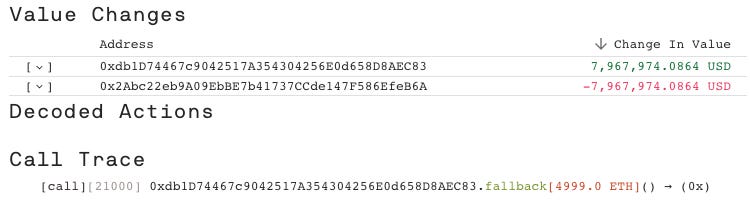
On September 24th, the Huobi Global exploit on the Ethereum Mainnet resulted in a $8 million loss due to the compromise of private keys. The attacker executed the attack in a single transaction by sending 4,999 ETH to a malicious contract. The attacker then created a second malicious contract and transferred 1,001 ETH to this new contract. Huobi has since confirmed that they have identified the attacker and has extended an offer of a 5% white hat bounty reward if the funds are returned to the exchange.

.jpg)