The Death of "Audit and Pray": Why Web3 Security Needs a Complete Rethink
The Web3 industry has a dirty secret that nobody wants to talk about: 90% of exploited smart contracts had been audited. Companies are paying anywhere from $25,000 to $500,000 per audit, with some getting 10+ audits, and still losing millions in a matter of seconds.
This isn't a bug in the system. This is the system itself being fundamentally broken.
The Three Reasons Web3 Security Is Different
Anyone who tells you Web3 security is just "Web2 with extra steps" doesn't understand the attack surface. There are three critical differences that make Web3 exponentially harder to secure:
1. No room for error. In Web2, we have the luxury of "move fast and break things." Ship code, find bugs, patch, redeploy. Rinse and repeat. In Web3, deploying or changing your source code is a completely different beast. You can't just slap a patch on a smart contract the way you push a hotfix to production on a Friday afternoon.
2. Complete transparency. Web2 benefits from layers of firewalls and security systems that protect underlying code. In Web3, everything is on-chain. Anyone can deduce your source code or bytecode. Every potential attacker can study your contract at their leisure, looking for vulnerabilities. There's no security through obscurity here.
3. Direct access to liquidity. This is the real killer. In Web2, a breach means stolen data. Yes, regulatory consequences suck. Yes, reputational damage is real. But it's not the same as watching $121 million drain from your protocol in seconds. Or $9.56 million. Or $1.8 million. These aren't hypothetical scenarios. These are real exploits that happened to real protocols in 2025 alone.
When your entire company can go under via a single exploit, security isn't just important. It's existential.
Why The Audit Model Is Dead
The traditional audit model made sense in a world where security reviews were the only option. Get a reputable firm to look at your code, fix what they find, deploy with confidence. Except the numbers prove this model is catastrophically insufficient.
Here's the uncomfortable truth: a human auditor can only find so much. Even the best security researchers, working for the most reputable firms, miss things. They have to. The complexity of modern DeFi protocols, combined with the composability of smart contracts and the ever-evolving attack vectors, makes comprehensive manual review nearly impossible.
And yet, we've built an entire industry around this fundamentally limited approach. Developers deploy contracts, get their audit badge, and hope for the best. It's security theater masquerading as actual protection.
The economics are absurd. Protocols are spending $25,000 to $500,000 per audit, often undergoing multiple audits from different firms, and still getting exploited. The spend keeps increasing, the audit count keeps rising, but the exploit rate remains stubbornly high. At what point do we admit this isn't working?
The Real Problem: Attack Surface at Scale
The Web3 ecosystem isn't just growing. It's accelerating toward mass adoption. Every major financial institution is allocating budget to on-chain initiatives. The average Fortune 500 company has $50-100 million earmarked for blockchain projects. Stripe is acquiring Web3 companies. Circle went public. Mastercard, Goldman Sachs, JP Morgan are all deploying on-chain.
We're maybe 3-4 years away from the escape velocity moment, 5-6 years from mass adoption. And we're trying to secure this explosive growth with a model that's already failing at current scale.
Think about what this means: if everyone's going to be on-chain in the next 10-15 years, we need to be able to onboard the next 10 million users. We need these deployments to be secure, fast, and cheap. The current model can't handle that. We can't 10x the number of auditors and expect 100% success rates. That's not how humans work.
The Solution: Security-First Development
The future of Web3 security isn't about better audits. It's about embedding security directly into the development process. It's about automating what historically was done manually, and doing it 5-10x better.
This means:
Proactive, not reactive. Instead of waiting for an audit to tell you what's wrong, developers need tools that catch vulnerabilities during development. Security can't be an afterthought or a final checkpoint. It needs to be built into every step of the workflow.
Continuous, not one-time. Security isn't a box you check before deployment. It's an ongoing process. The attack vectors evolve, the DeFi landscape shifts, and your security posture needs to adapt in real-time.
Automated, not manual. If we're going to scale to millions of developers deploying on-chain, we need automation. Not AI pattern-matching that gives false confidence, but rigorous formal verification, symbolic execution, fuzzing. Deterministic methods that provide mathematical proof of security properties.
Beyond the Developer
Here's something most people miss: Web3 security isn't just about protecting protocols. It's about protecting people's life savings.
In the US, we have the luxury of putting money in a bank and trusting it'll be there tomorrow. We don't think twice about our 4% returns or worry that our savings will evaporate overnight. But in Venezuela, Brazil, and dozens of other countries, people rely on decentralized protocols for financial autonomy. When these protocols fail due to security vulnerabilities, it's not just some protocol losing TVL. It's people losing everything.
That's the real stakes here. Security infrastructure isn't just enabling the next wave of DeFi innovation. It's enabling financial freedom for millions of people who don't have the safety nets we take for granted.
The Path Forward
The Web3 industry is at an inflection point. We can keep pretending that audits are sufficient, keep watching protocols lose millions to preventable exploits, keep forcing developers to choose between speed and security. Or we can acknowledge that the emperor has no clothes and build security infrastructure that actually works.
The technical problems are hard: symbolic execution, formal verification, automated testing at scale. But they're solvable. What's needed is a fundamental shift in how we think about security in Web3. Not as a final stamp of approval, but as a continuous, automated, developer-first process.
Because when billions of dollars and millions of people's financial futures are at stake, "audit and pray" isn't good enough. It never was.
The rich text element allows you to create and format headings, paragraphs, blockquotes, images, and video all in one place instead of having to add and format them individually. Just double-click and easily create content.
A rich text element can be used with static or dynamic content. For static content, just drop it into any page and begin editing. For dynamic content, add a rich text field to any collection and then connect a rich text element to that field in the settings panel. Voila!
Headings, paragraphs, blockquotes, figures, images, and figure captions can all be styled after a class is added to the rich text element using the "When inside of" nested selector system.
Follow-up: Conduct a follow-up review to ensure that the remediation steps were effective and that the smart contract is now secure.
Follow-up: Conduct a follow-up review to ensure that the remediation steps were effective and that the smart contract is now secure.
In Brief
Remitano suffered a $2.7M loss due to a private key compromise.
GAMBL’s recommendation system was exploited.
DAppSocial lost $530K due to a logic vulnerability.
Rocketswap’s private keys were inadvertently deployed on the server.
Hacks
Hacks Analysis
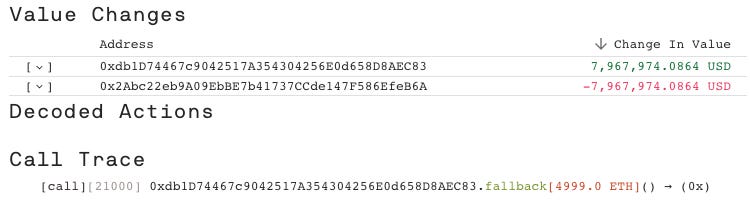
Huobi | Amount Lost: $8M
On September 24th, the Huobi Global exploit on the Ethereum Mainnet resulted in a $8 million loss due to the compromise of private keys. The attacker executed the attack in a single transaction by sending 4,999 ETH to a malicious contract. The attacker then created a second malicious contract and transferred 1,001 ETH to this new contract. Huobi has since confirmed that they have identified the attacker and has extended an offer of a 5% white hat bounty reward if the funds are returned to the exchange.