Stop Treating the Audit as Your Security Strategy. It Is a Receipt, Not a Shield.
The only scalable path to secure smart contracts starts at the keyboard, not in the audit report.
There is a number that should disturb every protocol founder, every DeFi developer, and every investor who has ever put capital into an onchain application: 90%. That is the approximate share of exploited smart contracts that had already passed a professional security audit before they were drained.
Nine out of ten protocols that suffered a significant exploit had done the thing the industry told them to do. They hired auditors. They paid the bill. They got the report. And they still lost user funds.
The audit is not the problem. The assumption that the audit is sufficient is the problem.
Smart contract security has, for years, operated on a fundamentally flawed mental model: treat security as a gate at the end of the development process, hand the code to a third party, wait for a report, patch what they found, and ship. It is a model borrowed from enterprise software, and it was never a good fit for code that controls billions of dollars, runs without administrators, and cannot be patched after deployment without a governance vote.
The industry needs a better model. And that model starts not with the auditor, not with the security firm, and not with the bug bounty program. It starts with the developer.
Why Point-in-Time Audits Cannot Scale
An audit is a snapshot. A team of experts reads your code at a specific moment in time, applies their knowledge of known vulnerability classes, and produces a report. It is valuable. It catches things that automated tools miss. Good auditors bring pattern recognition built from years of reviewing contracts across dozens of protocols. None of that is dispensable.
But audits have hard limits, and those limits compound as the ecosystem grows.
The throughput problem
The global supply of qualified smart contract auditors is small, the demand for audits is large and growing, and the time required to audit a complex protocol properly is measured in weeks. That mismatch creates backlogs, which creates pressure to rush audits, which reduces their effectiveness. As DeFi expands and more protocols launch, this bottleneck gets worse, not better.
The timing problem
Audits happen after code is written. In many cases, they happen after significant engineering effort has been invested in architectural decisions that are difficult to reverse. When an auditor flags a structural vulnerability late in the process, the fix is expensive: not just financially, but in terms of engineering time, re-testing, and delayed launches. Security feedback delivered too late is not just less useful. It is often ignored in favor of shipping.
The coverage problem
Even the best auditors miss things. Not because they are not skilled, but because manual review of complex, interdependent codebases is genuinely hard, and the adversarial creativity of attackers evolves continuously. Flash loan attacks, reentrancy variants, oracle manipulation, and cross-contract interaction bugs have each caught auditors off-guard at various points. No manual review process can claim comprehensive coverage.
Audits are necessary. They are not sufficient. And building a security strategy that treats them as the primary line of defense is a bet that gets worse every year.
The Developer Is the First Line of Defense
If audits are the last gate, the developer is every gate before it. And right now, most of those gates are unmanned.
The average smart contract developer writes code in an environment with almost no real-time security feedback. They may have linting tools that catch syntax errors. They may run a test suite that verifies expected behavior. But the tools that would tell them, as they write, that a function is reentrancy-vulnerable, that an unchecked external call could be manipulated, or that a price oracle is being read without a TWAP: those tools are largely absent from the default development experience.
This is not a developer failure. It is an infrastructure failure. The developer cannot defend against what they cannot see.
Security knowledge is not evenly distributed
There is a meaningful gap between what senior security researchers know about smart contract vulnerability classes and what the average protocol developer knows. That gap is not a character flaw. It reflects the youth of the ecosystem and the steep, non-standardized learning curve into Web3 development. A developer who came from a traditional backend background can write perfectly idiomatic Solidity and still ship a contract with a critical vulnerability because the mental models from their previous experience do not map cleanly onto the execution model of the EVM.
The auditor's job, in part, is to bridge that gap. But bridging it once, at the end of development, is a profoundly inefficient way to transmit security knowledge. The better approach is to embed that knowledge into the developer's workflow so that the gap closes continuously, in real time, rather than in a post-audit debrief.
What developer-embedded security actually looks like
Developer-first security is not a philosophy. It is a set of concrete practices and tools that move security left: closer to the moment when code is written, and far away from the moment when it is about to ship.
In practice, it means several things working in concert:
Static analysis running on every commit, flagging known vulnerability patterns before code ever reaches a reviewer
Fuzzing integrated into the CI/CD pipeline, automatically generating adversarial inputs to find edge cases that unit tests miss
Mutation testing to verify that the test suite is actually catching bugs, not just passing because no one thought to try the right inputs
Formal verification for critical logic paths, providing mathematical proof of correctness rather than probabilistic confidence
Security-aware code review tooling that surfaces vulnerability context inline, so reviewers know what to look for
None of these replace the auditor. But each of them means that by the time an auditor sees the code, the obvious issues are already resolved, and the audit can focus on the subtle, complex vulnerabilities that require human expertise to identify. The auditor's time is spent where it is most valuable, not on catching mistakes that a linter could have caught in milliseconds.
The CI/CD Pipeline as a Security Layer
Continuous integration and continuous delivery pipelines have become the standard operating environment for serious software development. Every commit triggers a build. Every build triggers a test suite. Failures block merges. The pipeline is, by design, the mechanism through which quality standards are enforced at scale without requiring human review of every line of code.
Smart contract development has largely adopted CI/CD for testing and deployment. It has been much slower to adopt it for security. That asymmetry is the low-hanging fruit of the developer security problem.
If a team already has a CI/CD pipeline, integrating security tooling into it is a tractable engineering problem. The cultural shift required is not enormous: security checks are just another class of test. They run on every commit. They block merges when they fail. They generate reports that developers review and address.
What this looks like in production
A protocol that has embedded security into its CI/CD pipeline runs a workflow like this:
Developer pushes a commit
Static analysis runs automatically, checking for reentrancy, integer overflow, access control issues, and dozens of other vulnerability classes
Fuzz testing generates thousands of adversarial inputs against critical functions
Mutation testing verifies that the test suite is robust enough to catch introduced bugs
Any failures block the pull request from merging
Developers receive inline feedback explaining the vulnerability, why it matters, and how to fix it
This is not a theoretical future state. It is a workflow that exists and is being adopted by teams that take security seriously.
Security checks that run on every commit catch vulnerabilities at the cheapest possible moment: before they are baked into the architecture, before they reach the auditor, and long before they reach an attacker.
Training Is Infrastructure, Not a One-Time Event
Tools alone are not enough. A developer who receives a static analysis flag about a reentrancy vulnerability but does not understand what reentrancy is, why it is dangerous, or how to fix it correctly will not be made more secure by the flag. They will either dismiss it, apply a superficial fix, or create a new vulnerability in the process of addressing the old one.
Security training for smart contract developers is not a one-time onboarding exercise. It is ongoing infrastructure, as continuous as the code itself.
The problem with current security education
Most smart contract security education exists in formats that are difficult to access at the moment they are needed: blog posts written after notable exploits, conference talks, audit reports from other protocols, and courses that require dedicated time to complete. This content is valuable, but it is not embedded in the workflow. A developer in the middle of writing a contract is not stopping to read a post-mortem from 18 months ago.
Effective security training reaches developers when they are most receptive: when they are already engaged with the specific vulnerability class in question, because they just received a flag about it in their own code. A static analysis warning that links directly to an explanation of the vulnerability, historical examples of exploits that resulted from it, and concrete patterns for avoiding it is worth more than a security workshop delivered once a quarter.
Building security intuition at scale
The long-term goal of developer-embedded security is not just to catch vulnerabilities. It is to produce developers who write fewer of them in the first place. Security intuition is learnable. It builds over time, from repeated exposure to vulnerability patterns, from seeing flags in real code, and from understanding why certain patterns are dangerous.
An ecosystem in which most developers have internalized the major vulnerability classes is a much safer ecosystem than one in which all security knowledge is siloed with a small number of expert auditors. The only scalable path to the former is through the developer toolchain, through tools that teach as they protect.
The Economic Argument for Shifting Left
Security has a cost curve. Vulnerabilities are cheapest to fix when they are discovered early and most expensive to fix when they are discovered late. This is true in all software engineering. In smart contracts, the stakes are compressed to an extreme.
Discovery MomentCostCaught in developmentHours to fixCaught in auditDays to fix + audit fees + potential launch delayCaught by an attackerPotentially everything
The math is not subtle. Shifting security left is not just the ethically correct approach to building protocols. It is the economically rational one. The teams that have adopted continuous, automated security tooling are not doing so out of idealism. They are doing so because the expected cost of a late-discovered vulnerability dwarfs the cost of the tooling by orders of magnitude.
For protocols handling significant user funds, the calculus is straightforward: the cost of developer-first security infrastructure is a rounding error compared to the cost of a single exploit.
What the Next Generation of Secure Protocols Looks Like
The protocols that will define the next phase of DeFi will not be distinguished primarily by the auditors they hired. They will be distinguished by the security culture embedded in their development process: the depth of their test coverage, the rigor of their fuzzing, the formalism of their critical logic, and the speed at which their teams can identify and close vulnerabilities.
That culture does not emerge from a single audit report. It is built incrementally, through tooling choices, through team norms, through the decision to treat security as a first-class engineering concern rather than a compliance checkbox.
The developers building those protocols are not waiting until they are ready to launch to think about security. They are thinking about it on every commit. Their tools are watching with them.
The first line of defense is not the auditor. It is the developer. And the developer needs infrastructure worthy of that responsibility.
The Path Forward
The smart contract industry has spent years learning, at significant cost, that manual audits alone are insufficient. The lesson has been expensive, measured in billions of dollars of drained protocols and the eroded trust that follows each exploit.
The answer is not to abandon audits. It is to stop treating them as the primary security mechanism and start treating them as the last line of a defense that begins much earlier: in the developer's IDE, in the CI/CD pipeline, in the continuous feedback loops that make security knowledge accessible at the moment it is most needed.
The first line of defense is the developer. Building the tools, training, and automation that empower developers to fulfill that role is not a feature of mature security posture. It is the foundation of it. Protocols that understand this early will be the ones still standing when the next wave of exploits hits.
Olympix builds proactive security infrastructure for smart contract development: static analysis, fuzzing, mutation testing, and formal verification integrated into the CI/CD pipeline. Learn more at olympix.security.
What’s a Rich Text element?
The rich text element allows you to create and format headings, paragraphs, blockquotes, images, and video all in one place instead of having to add and format them individually. Just double-click and easily create content.
A rich text element can be used with static or dynamic content. For static content, just drop it into any page and begin editing. For dynamic content, add a rich text field to any collection and then connect a rich text element to that field in the settings panel. Voila!
Headings, paragraphs, blockquotes, figures, images, and figure captions can all be styled after a class is added to the rich text element using the "When inside of" nested selector system.
Follow-up: Conduct a follow-up review to ensure that the remediation steps were effective and that the smart contract is now secure.
Follow-up: Conduct a follow-up review to ensure that the remediation steps were effective and that the smart contract is now secure.
In Brief
Remitano suffered a $2.7M loss due to a private key compromise.
GAMBL’s recommendation system was exploited.
DAppSocial lost $530K due to a logic vulnerability.
Rocketswap’s private keys were inadvertently deployed on the server.
Hacks
Hacks Analysis
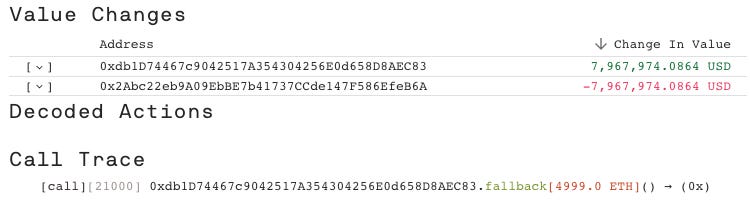
Huobi | Amount Lost: $8M
On September 24th, the Huobi Global exploit on the Ethereum Mainnet resulted in a $8 million loss due to the compromise of private keys. The attacker executed the attack in a single transaction by sending 4,999 ETH to a malicious contract. The attacker then created a second malicious contract and transferred 1,001 ETH to this new contract. Huobi has since confirmed that they have identified the attacker and has extended an offer of a 5% white hat bounty reward if the funds are returned to the exchange.