Ledger, Heco, Kronos, Raft: Exploits in the Supply Chain, Keys, and Math
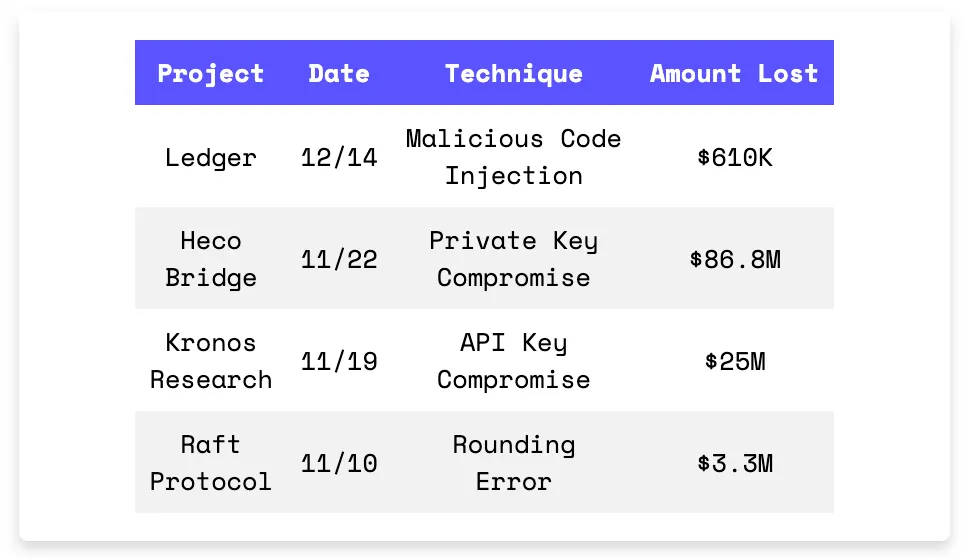
Ledger’s $610K exploit wasn’t on-chain — it was in the supply chain, via a poisoned NPM package. Heco Bridge lost $86.8M to key compromise, while Kronos Research lost $25M to leaked API credentials. Raft Protocol? $3.3M gone due to precision flaws in share minting logic. These weren’t contract bugs; they were infrastructure failures — up and down the stack.
In Brief
Ledger got exploited for $610K.
Heco Bridge lost $2.5M due to private key compromise.
Kronos Research was hacked due to API key compromise.
Raft Protocol was exploited for $3.3M due to malicious code injection.
Hacks Analysis
Ledger | Amount Lost: $610K
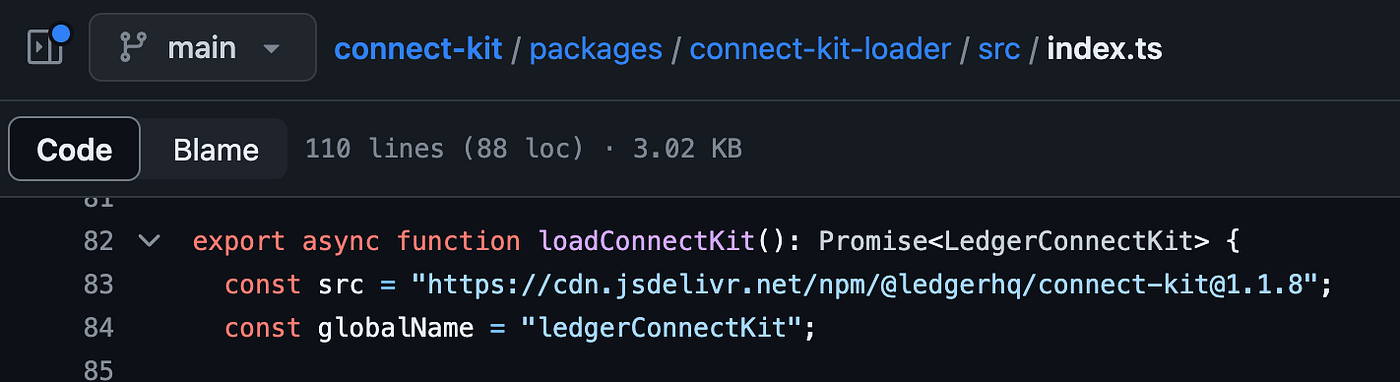
On December 14th, the Ledger exploit on multiple chains resulted in a $610K loss. The root cause of the exploit was that a former Ledger employee had their NPM JS account compromised. Since Ledger relied on a CDN without a version constraint, the attacker was able to inject malicious code into the @ledgerhq/connect-kit npm library. This malicious code allowed the attacker to drain funds and make a profit. Multiple DeFi platforms including PancakeSwap, SushiSwap, and Harvest Finance were affected.
On November 22nd, the Heco Bridge exploit on the Ethereum Mainnet resulted in a $86.8M loss due to the compromise of private keys. The attacker was able to withdraw funds, exploiting vulnerabilities in the withdrawal() function. The initial targeted hot wallet was drained for 4.25M KOK tokens and 2.19M ARIX tokens. Other stolen assets include USDT, HBTC, SHIB, UNI, USDC, LINK, ETH, and TUSD. The HTX team acknowledged the incident and assured the affected users would be compensated
On November 19th, Kronos Research exploit on the Ethereum Mainnet resulted in a $25M loss. Kronos Research announced the root cause as the unauthorized access of their API keys. The attacker executed six transactions, transferring varying amounts of ETH to different addresses. The Kronos team acknowledged the exploit, halted all trading, and stated that losses totaling over 12,800 ETH are not a substantial portion of its equity.
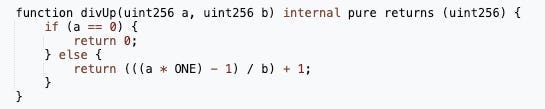
On November 10th, the Raft Protocol exploit on the Ethereum Mainnet resulted in a $3.3M loss due to a precision calculation flaw during share token minting. The attacker borrowed 6,000 cbETH in flash loans from AAVE, and transferred 6,001 cbETH to the InterestRatePositionManager contract, subsequently liquidating a pre-existing position. Exploiting a precision flaw, the attacker amplified the cbETH balance, minting 1 wei share through the divUp() function’s manipulation. By manipulating index values, the attacker minted an inflated amount of R tokens. The attacker then sold 6.7M R tokens for 1,575 ETH across various pools and made a profit.
The rich text element allows you to create and format headings, paragraphs, blockquotes, images, and video all in one place instead of having to add and format them individually. Just double-click and easily create content.
A rich text element can be used with static or dynamic content. For static content, just drop it into any page and begin editing. For dynamic content, add a rich text field to any collection and then connect a rich text element to that field in the settings panel. Voila!
Headings, paragraphs, blockquotes, figures, images, and figure captions can all be styled after a class is added to the rich text element using the "When inside of" nested selector system.
Follow-up: Conduct a follow-up review to ensure that the remediation steps were effective and that the smart contract is now secure.
Follow-up: Conduct a follow-up review to ensure that the remediation steps were effective and that the smart contract is now secure.
In Brief
Remitano suffered a $2.7M loss due to a private key compromise.
GAMBL’s recommendation system was exploited.
DAppSocial lost $530K due to a logic vulnerability.
Rocketswap’s private keys were inadvertently deployed on the server.
Hacks
Hacks Analysis
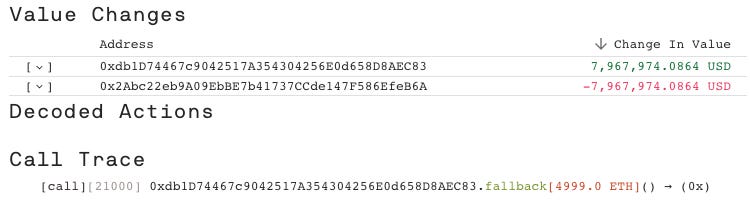
Huobi | Amount Lost: $8M
On September 24th, the Huobi Global exploit on the Ethereum Mainnet resulted in a $8 million loss due to the compromise of private keys. The attacker executed the attack in a single transaction by sending 4,999 ETH to a malicious contract. The attacker then created a second malicious contract and transferred 1,001 ETH to this new contract. Huobi has since confirmed that they have identified the attacker and has extended an offer of a 5% white hat bounty reward if the funds are returned to the exchange.